Paving
Prioritize parking lots for sealcoat and repair surveys
Prioritize parking lots by service fit, a documented reason to inspect, buyer access, closure feasibility, and travel time. Walk the pavement before choosing sealcoat or repair.
Direct answer
Prioritize parking lots for sealcoat and repair surveys by checking service fit, a dated reason to inspect, the buyer's approval process, workable closures, and route time. Score those items consistently, then arrange a measured walk. Keep suspected structural failures in a repair investigation queue, and keep unverified pavement condition marked unknown. A high prospect score earns survey attention; it does not establish that sealcoat is suitable or that an owner wants a quote.
On this page
How do you prioritize parking lots for a survey?Build the property recordWhat can photos tell you before the walk?Which lots belong in the repair queue?Survey priority scoreWorked priority example: three propertiesWhat should the survey measure?Worked scope and money exampleWhat can change the example margin?How do closures, weather, and accessibility change priority?What to document and hand offCommon mistakesField checklistStandards and referencesUnits and termsRelated Anvilfield guidesMethodologyOpen the related tool for the calculation, checklist, or packet.
FieldOS by AnvilfieldOffline-first FieldOS for job photos, proof packets, property memory, calculations, teams, billing, and owner-ready reports.How do you prioritize parking lots for a survey?
Start with properties your crew can serve, then rank the evidence that a useful survey can happen. Confirm the pavement type, a maintenance concern, the person responsible, possible closure windows, and added travel time. Put the strongest documented opportunities on the next survey route. Do not start with the largest gray rectangle on a map and work backward toward a sealcoat price.
Keep two decisions separate on the worksheet. The commercial decision is whether to spend estimating time here. The technical decision is what the pavement needs. An occupied office lot may be an excellent account even if its entrance needs investigation before a preservation proposal. A huge warehouse lot may remain a weak prospect because nobody has confirmed responsibility or permission to walk it.
The Federal Highway Administration's preservation guidance says preservation generally does not add structural value. Use that boundary when qualifying the work: a surface coating cannot substitute for an investigation of suspected support failure. Give urgent hazards their own owner notification and response process, regardless of the property's sales score. This worksheet schedules prospect surveys; it does not schedule emergency repairs or replace a pavement management plan.
FHWA guidance on preservation and maintenanceBuild the property record
Give each property one record before anyone calls or drives. Use the site address and parcel reference to avoid counting separate tenant names as separate lots. Split physically different parking areas into sections, especially where one owner controls the front parking and another party maintains a shared drive. Record who supplied each fact and when you checked it.
Use available parcel information, owner records, permits, previous contracts, and dated imagery as research inputs. Ask the manager to confirm who controls maintenance; an ownership entry does not establish purchasing authority. Save the document reference rather than writing 'old asphalt' from memory. A paving permit may describe one entrance instead of the entire lot. To expand that property file beyond referrals, PorchRocket's Ground Control supplies commercial building lists within 48 hours; the maintenance buyer still needs to be confirmed.
Keep paved area, building size, and parcel area in separate fields. Only the work boundary becomes a pavement quantity. Mark desk measurements as preliminary and record their exclusions. Leave unknown dates blank or explicitly unknown so another estimator does not turn a guess into a reseal anniversary.
| Field | What to keep and why |
|---|---|
| Site | Address, parcel reference, section sketch, shared drives. Avoid duplicate accounts and disputed boundaries. |
| Surface | Surface type, source date, visible coverage, unknown areas. Select the right survey and crew. |
| History | Invoice or owner report, treatment, location, date. Ask a specific condition question. |
| Buyer | Responsible role, approval process, permission, restrictions. Book a useful visit. |
| Route | Added travel minutes, proposed visit, owner deadline. Use the estimator's day well. |
What can photos tell you before the walk?
Use overhead views to sketch visible parking boundaries and entrances. Record the image date, areas hidden by vehicles or trees, and any uncertainty about surface type. Treat a dark patch as a location to inspect. Its color alone does not tell you whether it is wet, recently treated, contaminated, or structurally sound. A roof or building size filter is not a pavement measurement.
For the field record, take an overview, a section view, and a close view with a scale at the same numbered location. Record direction, date, wet or dry conditions, and what was inaccessible. An overview locates the concern; the closer view supports measuring it. Neither shows buried layer thickness or proves the cause of failure. Keep those unknowns attached to the photos.
The two FHWA photos below illustrate different fatigue cracking examples on roads, not a before-and-after pair or surveyed customer properties. They are training references. In the wider view, fine cracking is harder to distinguish. The closer example shows interconnected cracking and a scale, but still cannot establish the repair depth. Do not transfer either image's severity label to a prospect without a site assessment.
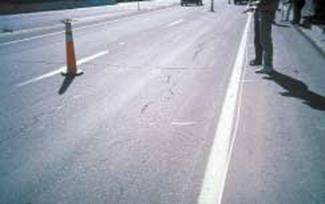
FHWA figure 5, low severity fatigue cracking. Visible: the road context and crack traces. Unverified: crack dimensions, support condition, and repair depth.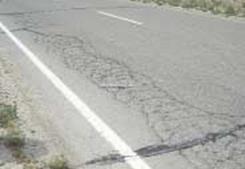
FHWA figure 7, high severity fatigue cracking. Visible: a connected crack pattern. Unverified: failed layer, water source, and excavation boundary.FHWA distress manual, May 2014, chapter 1 and figures 5 and 7Which lots belong in the repair queue?
Route a property by the question that needs answering. A preservation survey asks whether suitable pavement needs preparation, crack treatment, and coating. A repair survey asks what has failed, how far the repair extends, and whether another specialist or investigation is needed. One property can need both surveys in different sections.
Use the following as triage prompts, not treatment specifications. The FHWA distress manual distinguishes fatigue cracking, block cracking, potholes, and deformation. Photograph and measure the observed pattern before proposing a cause. Repeated failure at one location deserves the previous repair record and a closer investigation, not an automatic repeat of the last invoice.
| Evidence or uncertainty | Survey route and question before pricing |
|---|---|
| Owner reports worn coating; current pavement condition unknown | Preservation assessment. Is the surface suitable, and what preparation is required? |
| Interconnected wheel path cracks, a recurring hole, or deformation | Repair investigation. What layers and boundaries need investigation or replacement? |
| Ponding report, settled inlet edge, or repeated wet patch | Drainage and pavement review. Where does water collect, and what controls the repair? |
| Accessible route or parking layout concern | Accessibility and scope review. Who will confirm the required layout and measured geometry? |
| New pavement, recent treatment, or unclear material | History and product review. Is any treatment due or compatible? |
| Unconfirmed owner, hidden lot, or no survey permission | Research and contact. What evidence or permission is missing? |
Survey priority score
Use this suggested 100-point worksheet to rank survey effort. The weights and thresholds are editorial operating choices, not a published prediction of sales or pavement performance. Apply the same version to the whole batch. For every factor, save the supporting note, source, date, and scorer. Unknown earns zero until verified; it does not mean the property lacks a need.
First apply the gates: the property must be within your chosen service territory and the likely work must be within your capability or an arranged specialist's capability. Respect an owner's refusal. Obtain permission and a safe access arrangement before entering. A score cannot override these conditions.
For an initial trial, put scores of 70 or more into the next available survey slots, 45 to 69 into targeted follow-up, and 0 to 44 into research or a dated hold. Break ties by added travel time and the owner's confirmed timing. Flag urgent conditions separately and notify the responsible party promptly. After the first batch, compare survey usefulness and estimating hours before adjusting the weights.
Do not label this score PCI. ASTM D6433-24 addresses the Pavement Condition Index, a visual pavement condition survey method. ASTM's public scope also states that PCI does not measure structural capacity. Our prospect score does not rate pavement condition at all. Record an actual PCI only when the specified survey has been performed.
ASTM D6433-24 public scope and significance| Factor and scoring evidence | pt |
|---|---|
| Service fit. 0: unknown or unsuitable. 15: asphalt identified, treatment unresolved. 30: recent records or walk support work your team offers. | 30 |
| Reason to survey. 0: color alone or no dated signal. 10: older record or unconfirmed concern. 25: current owner report or dated defect evidence needing measurement. | 25 |
| Buyer path. 0: unknown. 10: responsible contact identified, process unclear. 20: manager confirms responsibility and approval process. | 20 |
| Closure feasibility. 0: unknown or unworkable. 5: restrictions recorded, plan unresolved. 15: manager accepts a plausible phased closure, subject to product conditions. | 15 |
| Route fit. 0: travel economics unresolved. 5: within the chosen territory. 10: no more than 15 added driving minutes beside another booked visit, under this example policy. | 10 |
Worked priority example: three properties
These three typical properties are inside the same contractor's territory, have permitted survey access, and have no reported immediate hazard. The contractor offers preservation and localized repair; a specialist is available for investigation. A dated note supports the stated factor in each score below.
Maple has a recent maintenance record, a current owner concern, and workable closures. Creek has a recurring entrance problem and needs a repair investigation; its treatment and closure plan remain unresolved. West has only an older record, an identified contact, and no closure information. Its size does not fill those gaps.
Book Maple's preservation assessment and Creek's repair assessment on the same route. Call West to establish the approval process and present condition before spending a survey slot. Creek's score supports a visit, not a sealcoat recommendation. If access or the reported condition changes, date the new evidence and rescore rather than quietly overwriting the old reason.
| Sample property and preliminary area | Fit + reason + buyer + closure + route | Action |
|---|---|---|
| Maple offices: 40,000 sq ft | 30 + 25 + 20 + 15 + 10 = 100 | Assess coating |
| Creek medical offices: 28,000 sq ft | 15 + 25 + 20 + 5 + 10 = 75 | Assess repair |
| West warehouse: 110,000 sq ft | 15 + 10 + 10 + 0 + 5 = 40 | Confirm buyer and history |
What should the survey measure?
Walk each proposed work section with the manager or the agreed site contact. Start at the entrance, follow the traffic paths, and compare those areas with parking rows and less traveled edges. Mark drains, transitions, delivery areas, and excluded surfaces on one sketch. Record wet-weather complaints even when the inspection occurs on a dry day, and identify what needs a return observation.
Measure coat area separately from repair area. Measure crack treatment by length and record the condition and proposed preparation needed to price it. Mark patch boundaries as provisional until their repair basis is established. A crack inside an area scheduled for removal should not also be sold as a retained-pavement crack treatment. Keep uncertainty visible in the takeoff.
Read the selected product's instructions before promising the preparation scope. The current MasterSeal Concentrate sheet calls for a clean surface, crack filling, and cleaning and priming oil stains. That supports separate preparation observations; it does not prove that every stained or cracked surface is suitable for that product. Resolve compatibility and deteriorated material before specifying work.
Close the walk with a decision for every section: prepare a measured preservation proposal, investigate repair, request specialist review, monitor, or exclude. Write down why. If the owner only wants a budget, identify the unresolved quantities and inputs that prevent a fixed scope. A useful survey can end with a repair investigation rather than an immediate coating bid.
MasterSeal Concentrate technical data sheet, revised November 2, 2026Worked scope and money example
The sample Maple survey establishes a 40,000-square-foot gross boundary. Deduct 3,000 square feet of concrete and islands, leaving 37,000 square feet of asphalt. 1,000 square feet requires localized replacement, leaving 36,000 square feet in the immediate coating scope. Keep the fresh repair out of that coating scope until its readiness is confirmed; a later coating visit is not included.
In this typical repair, 4 inches of compacted asphalt replaces the surface over sound retained base. The case uses 1,200 linear feet of approved crack treatment outside the repair areas, two specified coating applications on the retained surface, and one measured striping schedule. The striping allowance covers a reviewed layout requiring no new signs, ramps, or grading.
The case uses four equipment mobilizations: repair, two coating phases, and final marking. The owner clears the work areas and provides the agreed closures. The example rates include the stated preparation, labor, materials, equipment, ordinary disposal, and traffic separation. The repair rate includes cutting, removal, tack, and compaction. Base replacement, drainage correction, testing, unusual contamination, and changed access are excluded and require a priced scope change. The selling rates apply to the defined scope.
$24,620 revenue - $17,800 direct job cost = $6,820 gross profit.
$6,820 / $24,620 = 27.7% gross margin.
$6,820 - $2,000 allocated overhead - $300 pursuit and survey cost = $4,520 before income tax.| Scope and revenue | Quantity and selling rate |
|---|---|
| Preparation and coating: $11,520 | 36,000 sq ft x $0.32, both coats included |
| Crack treatment: $2,100 | 1,200 linear ft x $1.75 |
| Localized asphalt replacement: $8,500 | 1,000 sq ft x $8.50 at modeled depth |
| Reviewed striping schedule: $1,600 | One allowance x $1,600 |
| Mobilizations: $900 | 4 x $225 |
| Total before any sales tax: $24,620 | Sum of stated items |
What can change the example margin?
Anvilfield research puts direct cost at $17,800, including all listed production labor with payroll burden, materials with purchase taxes, equipment, subcontract work, disposal, and the four mobilizations. The $2,000 overhead allocation and $300 pursuit cost are separate. The case uses payment in full, no retention or financing expense, and no additional work. Sales tax collected, if applicable, is outside revenue. Deduct any remaining costs to calculate net profit.
Now opening the repair reveals 500 square feet of base work costing an extra $4 per square foot in direct expense. That is $2,000. If you absorb it without additional revenue, gross profit drops to $4,820 and the remainder after the same overhead and pursuit cost falls to $2,520. The proposal needs an agreed authorization process for that discovery before excavation starts.
Use the lesson when ranking prospects. A manager who supplies access, history, and a clear change process may support a more useful estimate than a larger property with missing information. Do not assign a modeled win rate to a list of addresses. Track actual survey hours, proposals, signed work, and direct costs before judging whether the route pays.
How do closures, weather, and accessibility change priority?
Ask who can move vehicles, notify tenants, control deliveries, and reopen each phase. Put those names and responsibilities beside the work sketch. Do not award full closure points because a tenant says weekends are quiet. Confirm the manager's operating constraints and carry a fallback date into the proposal.
For MasterSeal Concentrate specifically, the November 2, 2026 sheet requires surface and ambient temperatures of at least 50 degrees F and rising, with no drop below 50 during application or the following 24 hours. Let each coat dry thoroughly before the next coat, and let the final coat dry for 24 hours before vehicle traffic. Confirm the complete product instructions and actual conditions before scheduling.
Accessibility can change the scope before coating quantities change. The U.S. Access Board identifies resurfacing or resealing as alterations and distinguishes ordinary maintenance examples. The Department of Justice's restriping guidance requires accessible spaces when covered parking facilities are restriped. Have the responsible reviewer establish the applicable scope, layout, and route requirements before pricing a simple repaint. Photograph the existing arrangement and measure the relevant geometry; repeating old lines is not evidence of compliance.
U.S. Access Board parking guideDepartment of Justice restriping compliance briefWhat to document and hand off
Send the estimator a section map, source dates, photo IDs, measured quantities, exclusions, buyer process, and closure notes. Keep the prospect score and the technical recommendation in separate fields. Assign an owner and due date to every unresolved item. 'Need more information' is not a next action until somebody knows which record or inspection is missing.
A weak note says, 'Big gray lot, good sealcoat lead.' A useful note says, 'Section A: measured retained asphalt and crack lengths attached. Entrance repair excluded pending investigation. Manager confirms purchasing process; delivery closure unresolved. Photo P03 shows interconnected cracks but no verified repair depth. Estimator to confirm the repair basis before issuing a price.' That wording tells the next person what they can use and what they must still check.
Close each survey with a dated disposition: proposal, investigation, owner follow-up, monitoring, or declined work. Preserve the original record when updating it. On the next review, compare why you booked the survey with what it produced, including time spent on unsuccessful estimates.
Common mistakes
- Ranking by pavement color or total parcel size while leaving the work boundary unknown.
- Calling a prospect score PCI, or treating either number as proof of structural capacity.
- Counting cracks inside removal areas again in the retained-pavement treatment quantity.
- Selling coating across fresh repairs without confirming product compatibility and readiness.
- Ignoring a small urgent hazard because the property has a low commercial score.
- Treating an identified owner as a buyer requesting quotes, or a tenant comment as closure approval.
Field checklist
Want this checklist to run itself on every job — with photo proof and a signed record crews can hand the customer? That's FieldOS.
Standards and references
Sources reviewed November 4, 2026. The references cover preservation limits, distress identification and photos, condition surveys, product instructions, and accessibility. FHWA's 2014 distress manual is an archived training reference. ASTM lists D6433-24 as active; this guide uses its public scope and significance, rather than the purchased procedure.
Use the owner's adopted specification and the selected product instructions for the actual work. Record the applicable state and local material restrictions, runoff controls, and agency requirements before specifying a sealer. No jurisdiction was selected for this example, so this article does not certify a product as locally permitted. Confirm those items for the property rather than copying a national rule list into the quote.
FHWA preservation guidance, February 25, 2016
FHWA distress identification, May 2014ASTM D6433-24 public scope, updated November 15, 2024
MasterSeal Concentrate sheet, revised November 2, 2026Units and terms
Use square feet for the measured coating and repair areas, linear feet for crack treatment, inches for an explicitly designed repair depth, and minutes for added travel. A mobilization is one planned equipment visit in this worksheet. Define its included tasks so the estimate and schedule agree.
Survey priority means where to spend estimating effort. Treatment suitability means whether the assessed section can receive the proposed work. An allowance is a modeled amount awaiting a defined scope; an exclusion is work absent from the price. Keep those labels visible wherever numbers travel into a proposal.
Methodology
Counts, prices, work rates, schedules and outcomes in typical cases are inputs to the Anvilfield research model. Calculations use the stated scope, formulas, cost inclusions and exclusions. Cited public records and technical documents support their attributed facts. The selling-rate model uses November 2026 planning inputs. Named case records, dates and outcomes are scenario inputs; cited public records retain their source attribution.
FAQ
Which parking lots should I survey first for sealcoat work?
Survey lots with documented service fit, a current reason to inspect, a confirmed buyer process, feasible closures, and efficient travel. Confirm treatment suitability on site. Large area or faded color alone does not establish a sealcoat opportunity.
Can aerial photos tell me that a parking lot needs sealcoating?
No. They can help locate visible pavement and plan a visit, but they do not establish treatment suitability, repair depth, or buying intent. Record the image date and hidden areas, then verify condition and quantities during an authorized walk.
Is the survey priority score a Pavement Condition Index?
No. The priority score ranks estimating effort using the suggested commercial factors. PCI concerns pavement surface condition under its specified survey method. Neither this prospect worksheet nor an attractive surface establishes structural capacity.
Should alligator cracking increase a sealcoat prospect's priority?
It should trigger a repair question, not automatic sealcoat eligibility. Document the interconnected cracking, obtain the repair history, and investigate the affected section. Notify the responsible party about urgent hazards independently of the sales ranking.
How should unknown information affect the score?
Give the affected factor zero and record what would resolve it. Unknown is a research task, not proof that the owner has no need. Update the score with dated evidence after contact or inspection.
Can I quote from the mapped parking area?
Use it for a preliminary planning quantity only. Verify the actual work boundary and deduct islands, concrete, excluded areas, and repairs outside the immediate coating scope. Measure crack treatment separately and identify unverified repair quantities.
Does resealing require an accessibility review?
Yes, include it in scope development. The Access Board treats resealing as an alteration, and the Justice Department provides accessible parking requirements for restriping. Confirm the applicable layout and route requirements with the responsible reviewer before pricing the work.
Does a parking lot property list mean the owners want quotes?
No. It identifies properties to research and contact. Establish maintenance responsibility, current concerns, timing, and permission for a measured survey before treating a property as a qualified opportunity.
People also ask
Codes cited in this guide
This guide is written and reviewed against the published standards below. Always confirm the current adopted edition with the authority having jurisdiction.